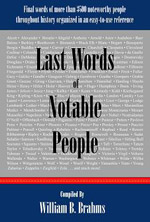
Last Words of Notable People
William B. Brahms. (2010). 680 pages.
Haddonfield, NJ: Reference Desk Press.
ISBN: 978-09765325-2-1
Press kit with sample pages (PDF)


The DRD was kindly offered a review copy of this book to be released in September 2010. DeathRef librarian Meg Holle took it to task, after a survey of similar works at local academic and public libraries.
A person’s last words — whether written in a diary or directly preceding the death rattle — tend to intrigue we the living, especially if the deceased, while alive, was otherwise fascinating or important. Even prosaic word salads have a special nihilistic charm. Yet throughout history, in addition to poor recordkeeping or merely mishearing or misremembering, we have been tempted to force meaning or change entirely the last words of the dead to preserve their dignity or prolong their profundity.
Many compilations of last words reflect this — that it is more important to be poetic than precise or to admit that we simply do not know the truth, disregarding scholarship and accuracy to perpetrate myths and cults of personality for their inspiration or wit. Such works tend to focus on the creative delivery of only a few people, while others merely list quotes devoid of context. Rarely do they name verifiable sources or show interest in or even admit to ambiguity beyond a brush-off disclaimer buried in the preface.
Last Words of Notable People is an ambitious effort to remedy this. Compiled by librarian and historian William B. Brahms, this reference work contains the final words of over 3,500 noteworthy people. With a focus on politicians, religious leaders, military people, writers, artists, musicians, athletes and criminals, last words are collected throughout history and around the world, with Americans and Europeans best represented. Arranged alphabetically by last name, each entry contains a short biography, the person’s last words, the context in which they were spoken or written and the source of the quote.
Last Words of Notable People especially excels at being unequivocal about ambiguity. It documents not only last words and their variations, but also completely different quotes when applicable. It also includes well-known last-word contrivances, clearly marked as “doubtful” in the text.
The book claims to be “the most authoritative compilation of Last Words ever assembled.” In a nice twist of honest, functional scholarship, its authority does not derive from claiming settled truth, but by acknowledging and sourcing the contradictions. While Brahms has necessarily made interpretive decisions regarding the content — what to include, omit, call “doubtful” and so forth — the reader is presented with evidence and citations for further investigation.
What exactly is scholarly interesting about last words, anyway? Let’s find out. I randomly examined the entry for civil rights activist Malcolm X, who was shot to death while giving a speech. After a brief bio, it states:
Last Words: “Hold it! Hold it! Let’s cool it! Let’s be cool, brothers!” Spoken to the three assassins who shot him multiple times.
Variation: “Let’s cool it brothers.”
For comparison, Alan Bisbort’s Famous Last Words (2001) has Malcolm X saying,
“Brothers and sisters, stay cool!”
…in effort to “maintain order in the assembly hall.”
While similar on the surface, these two versions are quite different. In the first quote and its variation, Malcolm X tries to deescalate the situation while also confronting and chiding his killers. In the second, he’s addressing the crowd. It’s reasonable to think that in the confusion, words were misremembered and to whom they were delivered, misconstrued.
But in this second version of “brothers” and being “cool,” “sisters” is also thrown in. Because that’s what he said? Or because of the politically correct, socially expedient reality that it’d be unfortunate for history to remember Malcolm X as forgetting women? — not just in the audience that he was gunned down in front of that day, but all women in all struggles, as this message apparently is, for all time, for everyone to keep their composure and dignity in the face of extreme adversity.
That is, if this was even actually spoken at all.
Brahms lists sources for both variants of the quote. Bisbort has none (to be fair, Bisbort’s work, with its stylish illustrations, is intended for trivial pursuit, not serious scholarship — yet if it’s incorrect… that’s a problem). It’s uncertain why Brahms did not list “Brothers and sisters, stay cool!” as alternative last words. The alleged quote may not be common enough to warrant inclusion, even with a “doubtful” notice, or perhaps it isn’t verifiable at all.
Suffice it to say, the depth of research that was required for this work is staggering, as is the potential range of inquiry it will assist and inspire, as historians investigate not only what people said, but all the ways in which last words are remembered, misheard and completely made up.
This death librarian is sold.
On the downside, while the dictionary format is intuitive and makes the most sense, the book is difficult to browse beyond aimlessly jumping around unless you have a specific person in mind. Additional points of access would improve usability and usefulness, such as a subject index by occupation, or perhaps a list of all the people with “doubtful” last words.
Finding entries by the content of the quote, as some works have done, would also be helpful, though such a task would be arduous and probably contentious (e.g., does Confederate Army General Robert E. Lee’s final utterance, “Strike the tent!” [“doubtful,” by the way] demonstrate valor or delusion?). The book does have an index, but it appears to consist mostly if not exclusively of personal names, making it largely redundant with the already alphabetical name entries.
Bottom line for Academic and Large Public Libraries: For as comprehensive it is, Last Words of Notable People is undeniably a niche resource. But the historians and biographers and general weirdos who run across it will flip out and fall in love as they discover — confirm, deny and further complicate — the final words of the famous.