Death Reference Desk

  • Home
  • About
  • Research Guides
  • Ask a Question!
  • Contact

DeathRef Tweets DeathRef Tweets

  • http://t.co/N8RHE9eou9 http://t.co/yOBK5WSl8o, May 18

Categories

  • Afterlife (12)
  • Burial (31)
  • Cemeteries (42)
  • Cremation (25)
  • Death + Art / Architecture (35)
  • Death + Biology (19)
  • Death + Crime (27)
  • Death + Disaster (9)
  • Death + Humor (35)
  • Death + Popular Culture (68)
  • Death + Technology (59)
  • Death + the Economy (34)
  • Death + the Law (101)
  • Death + the Web (41)
  • Death Ethics (73)
  • Death Ref Questions (2)
  • Defying Death (9)
  • Eco-Death (17)
  • Funeral Industry (37)
  • Grief + Mourning (30)
  • Monuments + Memorials (41)
  • Suicide (30)

We Like

  • Daily Undertaker
  • Death Care
  • Morbid Anatomy
  • Obit Magazine
  • Pushin Daisies
  • Taphophilia (dot) Com
  • Wikipedia Death Portal

Archives

  • May 2013
  • April 2013
  • March 2013
  • February 2013
  • January 2013
  • December 2012
  • November 2012
  • October 2012
  • September 2012
  • July 2012
  • June 2012
  • May 2012
  • March 2012
  • February 2012
  • January 2012
  • December 2011
  • November 2011
  • October 2011
  • September 2011
  • August 2011
  • July 2011
  • June 2011
  • May 2011
  • April 2011
  • March 2011
  • February 2011
  • January 2011
  • December 2010
  • November 2010
  • October 2010
  • September 2010
  • August 2010
  • July 2010
  • June 2010
  • May 2010
  • April 2010
  • March 2010
  • February 2010
  • January 2010
  • December 2009
  • November 2009
  • October 2009
  • September 2009
  • August 2009
  • July 2009
  • June 2009

Tags

animals anthropology Arlington Cemetery assisted dying attending your own funeral auctions audio Bali bio-cremation bioethics body fisherman books brain death capital punishment cardiac death celebrity death Cemeteries China civil rights coffins columbaria corpse abuse crafts cremains Cremation cryogenics cryonics cults death and art death and smell death masks death meditation death with dignity decomposition definition of death digital archiving digital assets Dignitas disease Edward and Joan Downes euthanasia Facebook films foreclosure forensics Foxconn free speech funeral directors funeral homes funerals games genealogy ghost bikes grave markers green burial guns Haiti Earthquake home burial homicide humor infographics informatics insurance investment Jack Kevorkian Japan jewelry last words lecture LGBT lifecasting living with the dead marketing mass graves medicine memorializing memorial tattoos Mexico mock funerals moment of death mortuary science mummies mysterious deaths obesity obituaries online memorials patents pet loss pets photos physician-assisted suicide planned giving plastination podcast postmortem photography premature burial promession protests public art QR codes religion research reusing graves roadside memorials same-sex partners seminars September 11 2011 soldiers soldier suicide spiritualism statistics stress Suicide suicide prevention superstition SxSW tattooing taxes TED talk thanatos tours twitter unclaimed bodies urns vertical burial video wayward bodies webcasting Westboro Baptist Church wills writing zombies

19,000 Facebook Users Die Each Day. Here is How FB’s Memorialization Mode Works

5 Feb
2012

The Facebook Show
On The Media, WNYC Public Radio (February 03, 2012)
An Austrian man who got Facebook to give him everything they had on him, a writer whose rapist friended her on Facebook, the value of a “Like.”

Living Online After Death Faces Nebraska Legal Battle
BBC News (January 31, 2012)

WNYC’s On the Media radio program dedicated this entire week’s show to Facebook and its users. Per usual, it was an excellent set of stories. I was a little surprised, however, that the program didn’t discuss what happens when Facebook users die.

So let me pick-up that storyline.

Let’s roll out some numbers. The current number of Facebook users is somewhere near 845 million. The rough annual mortality rate across the planet is 8.37 deaths per 1000 individuals (this number is gleaned from the CIA World Factbook on global mortality statistics and is far from exact, so we’re dealing in broad approximations). After doing a little math, this means that over 7 million Facebook users die each year. Divide that by 365 days and you’re looking at over 19,000 Facebook users dying every day.

By comparison, 1500 people die every day across England, Scotland and Wales. In America, over 6,000 people die a day. I could go on and on.

I was already thinking this week about death and Facebook since a handful of American states are either drafting legislation to enable next-of-kin access to social media accounts, and/or the laws have already been enacted. The BBC story at the top of the page discusses proposed legislation in Nebraska. You can see short summaries of both proposed and passed legislation here and here.

Facebook anticipated this situation a few years ago and the Death Reference Desk has been covering this situation since day one. You can see of all our posts on Facebook and Death here.

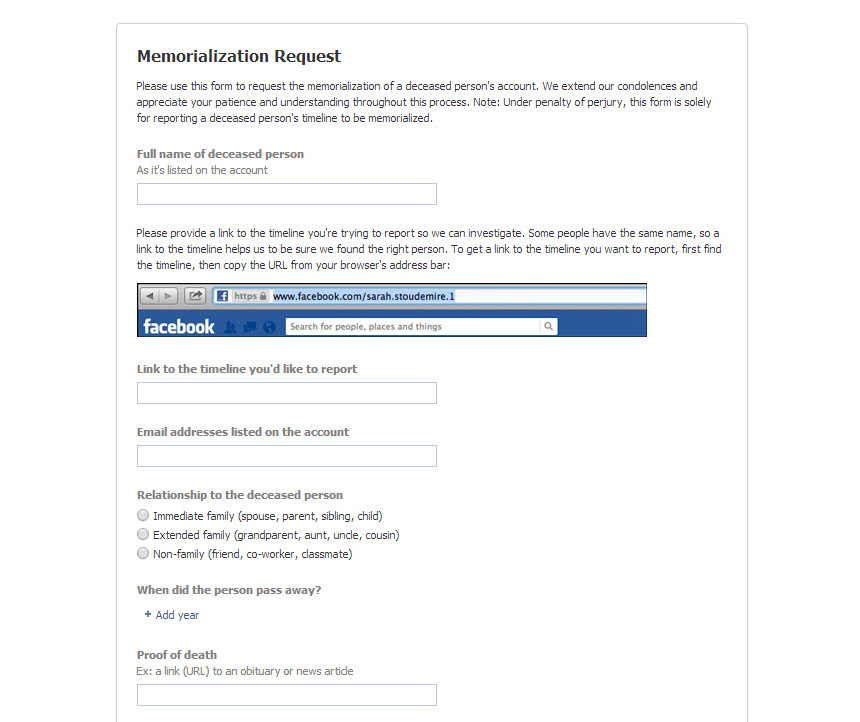
In 2009 (October 26, 2009 at 4:48pm to be exact) Facebook announced that it was now using something called Memorialization Mode for dead account holders. This Facebook blog post, Memories of Friends Departed Endure on Facebook by Max Kelly, explained how Memorialization Mode worked. Here are the key sections from the post:

We understand how difficult it can be for people to be reminded of those who are no longer with them, which is why it’s important when someone passes away that their friends or family contact Facebook to request that a profile be memorialized. For instance, just last week, we introduced new types of Suggestions that appear on the right-hand side of the home page and remind people to take actions with friends who need help on Facebook. By memorializing the account of someone who has passed away, people will no longer see that person appear in their Suggestions.

When an account is memorialized, we also set privacy so that only confirmed friends can see the profile or locate it in search. We try to protect the deceased’s privacy by removing sensitive information such as contact information and status updates. Memorializing an account also prevents anyone from logging into it in the future, while still enabling friends and family to leave posts on the profile Wall in remembrance.

So when Facebook is notified of someone’s death via the Report a Deceased Person’s Profile page then the account will be changed.

Now, I’ve never had to report a deceased person’s account (which is nice) so I don’t have any direct experience with how it works. I also can’t tell if Facebook has modified what happens to dead user accounts since the initial 2009 announcement.

Here’s the rub — at some point Facebook will require an entire department dedicated to User Mortality. At approximately 19,000 deaths a day, the situation can only be left to its own devices for so long.

If for any reason, to prevent false death notifications like this one.

Indeed, what Facebook needs is a Senior Vice President for User Mortality Affairs and the DRD Team is more than happy to take on that job, should FB’s headhunters be tooling around the Death Reference Desk.

But until that job offer arrives, we at Death Ref will continue to track how over 7 million deceased Facebook accounts are turned into ad hoc digital memorials.

RedditDiggFacebookTwitterStumbleUponDeliciousShare
  • By: John
  • In: Death + Popular Culture|Death + Technology|Death + the Law|Death + the Web|Grief + Mourning

  • Tags: Facebook, memorializing

9 Responses to 19,000 Facebook Users Die Each Day. Here is How FB’s Memorialization Mode Works

Obitsman

February 6th, 2012 at 10:28 am

Interesting topic. The actual number of deaths must be lower since FB user population skews younger than general population.

John

February 6th, 2012 at 11:20 am

Obitsman: That is likely the case. The 19,000 is an approximation. But I wouldn’t mind seeing mortality stats from FB on its users. If that’s even possible.

Reporting death to Facebook / Twitter.. Should they change their poilcy | e-membrance

February 6th, 2012 at 8:43 pm

[...] recent calculation done estimates 19,000 Facebook users die each day, the maths is very crude [...]

Reporting death to Facebook / Twitter.. Should they change their poilcy | e-membrance

February 24th, 2012 at 5:11 pm

[...] recent calculation done estimates 19,000 Facebook users die each day, the maths is very crude [...]

Diary of a Wimpy Catholic

March 20th, 2012 at 3:52 pm

[...] a permanent Dia de Los Muertes, where the living and the dead mingle freely. In 2009, Facebook rolled out its new “Memorial Mode.” When a Facebook user dies, his or her next-of-kin submits a [...]

May Perpetual Wall Posts Shine Upon Them « Diary of a Wimpy Catholic

March 20th, 2012 at 5:58 pm

[...] a permanent Dia de Los Muertes, where the living and the dead mingle freely. In 2009, Facebook rolled out its new “Memorial Mode.” When a Facebook user dies, his or her next-of-kin submits a [...]

» Social Media Web Users Keep Dying…Second Verse Same as the First Death Reference Desk

March 25th, 2012 at 12:49 pm

[...] radio program On the Media and its show on Facebook. That Death Ref post, subtly titled 19,000 Facebook Users Die Each Day. Here is How FB’s Memorialization Mode Works, discussed the current, non-stop discussions about what to do when web users (especially FB users, [...]

Kennedy-Mighell Report #81: Planning for Your Digital Estate

May 9th, 2012 at 5:04 pm

[...] 19,000 Facebook Users Die Each Day…. - Death Reference Desk [...]

Come segnalare una persona morta su Facebook | Trucchi Facebook

June 19th, 2012 at 5:50 am

[...] recente statistica (febbraio 2012) stima che ogni giorno muoiono circa 19mila utenti Facebook (e probabilmente adesso [...]

Comment Form

Your email will not be publicly revealed, and commenting is HTML friendly. If a Gravatar is attached to your email, it will be shown. Otherwise you'll see our studious lil' skelly friend.

top

Copyright ®2009 - 2013 Death Reference Desk | Disclaimer | Privacy

Powered by WordPress | Evidens White Theme by Design Disease